
Portuguese Citizenship Approved: What Now? the Next Steps
Has your case been completed at the IRN? See the practical order of the next steps (certificate, marital status, Citizen Card, passport, children, spouse, NIF and tax residence) and the mistakes that most often delay people who have just become Portuguese.
After months or years of waiting, the citizenship case shows as completed. It is great news, but it is also the point at which many people make mistakes that cost time: they apply for the Citizen Card with a name different from their Brazilian one, forget a marriage that was never registered in Portugal, leave their children for later or assume that the new citizenship changes their tax situation on its own.
This article shows the practical order of the next steps and the most common mistakes in each one. The details of each document (where to apply, official costs, validity and biometrics) are on our page about the Citizen Card, Portuguese passport and next steps. Here, the focus is on the sequence and on the decisions that come before the documents.
First of all: confirm what "completed" means in your case
In the case status lookup of the IRN (Institute of Registries and Notary), the "completed" (concluído) stage, when the application was approved, means that citizenship was granted and that it was registered in the Portuguese civil registry. Registration is what counts: under the current wording of the Nationality Act (Lei da Nacionalidade), the registration of acts of attribution and acquisition has constitutive effect (Art. 19(2), as worded by Organic Law 1/2026 (Lei Orgânica)).
It is also worth understanding from when you are Portuguese, because this affects your children and some registration acts:
- Children and grandchildren of Portuguese citizens (citizenship by origin): attribution takes effect from birth (Art. 11).
- Marriage, de facto union, residence and other acquisitions: the effects count from the date of registration (Art. 12).
Step 1: request the certificate and check it line by line
The Portuguese birth record is the basis for all the documents that will follow. The Citizen Card and the passport copy from it your name, parents, date and place of birth. For this reason, the first step is to request the online birth certificate and check each field against your Brazilian documents.
Pay special attention to four points: the spelling of your given name and surnames (accents, particles such as "de" and "da", the order of the surnames), your parents' names, the place of birth and your marital status. A small discrepancy today becomes a problem with banks, travel, inheritances and property records tomorrow.
Step 2: sort out marital status and name before applying for the card
This is the step most people skip. If you married, divorced or changed your name in Brazil, the Portuguese record will only reflect this after the proper registration act:
- Marriage: it must be registered in Portugal (Art. 1(1)(d) of the Civil Registration Code (Código do Registo Civil)). People who married in Brazil before obtaining citizenship should request the transcription of the marriage so that their marital status and any married name appear in the birth record.
- Divorce granted in Brazil: it is only annotated in the Portuguese record after it has been reviewed and confirmed (Art. 7 of the Civil Registration Code). See recognition of foreign judgments.
- Error in the birth record: the correction is made by annotation, usually by decision of the registrar (Arts. 92 and 93). If the error comes from the Brazilian certificate, the record must first be corrected in Brazil, through correction of public records.
Why before the card? Because the Citizen Card is issued with the data in the civil registry database, and the consulates warn that updates must be made before the application. Correcting it afterwards means paying and waiting twice.
Step 3: book your first Citizen Card
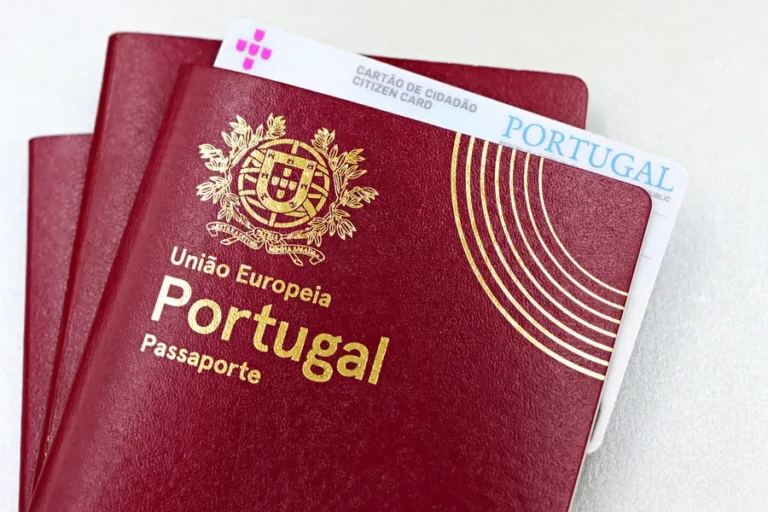
The Citizen Card (Cartão de Cidadão) is the identity document of Portuguese citizens and can only be requested by people who already have a Portuguese birth record (Justiça.gov.pt). The first application must be made in person: in Brazil, at the Portuguese consulate for your area of residence; in Portugal, at a Civil Registry Office (Conservatória do Registo Civil) or a Citizen Shop (Loja do Cidadão). Citizen Spaces (Espaços Cidadão) handle renewals only.
Choose the location based on your real life. If you live in Brazil, the card's address abroad has practical effects, such as voter registration in the corresponding consular section. If you will move to Portugal soon, consider whether it is worth waiting and applying there. Accepted documents, amounts and biometrics are on the page about the Citizen Card and passport.
With the first card, in addition to the civil identification number, you are assigned a NIF (Portuguese tax identification number), a Social Security number and a National Health Service user number (gov.pt). If you already have a NIF as a foreign national, mention it at the appointment to avoid duplicate numbers.
Step 4: activate the card and the Digital Mobile Key
The card comes with a PIN letter containing the activation codes. Keep it in a safe place, separate from the card. Once the card is active, you can activate the Digital Mobile Key (Chave Móvel Digital), which gives access to Portuguese online public services and, according to the consulates, is required to book most consular services. Doing this right away avoids future trips.
Step 5: apply for the Portuguese passport
The electronic passport is only issued to people who have a valid Citizen Card or Identity Card (Bilhete de Identidade) (Justiça.gov.pt). In practice, it always comes after the card. Before booking, compare the name that will appear on the passport with the one on your Brazilian passport: spelling differences are the most common cause of problems with airline tickets.
Step 6: children and spouse
Citizenship does not extend to your family on its own. Each person's route depends on how you became Portuguese:
- You are Portuguese by origin (child or grandchild of a Portuguese citizen): your children born abroad are Portuguese by origin if their birth is registered in the Portuguese civil registry or if they declare that they want to be Portuguese (Art. 1(1)(c)).
- You acquired citizenship (by residence, marriage or another route): your minor or legally incapacitated children can acquire it by declaration (Art. 2). Children born after your registration fall under the rule in item (c). Children who are already adults need their own route.
- Spouse or partner: a foreign national married for more than three years to a Portuguese citizen can acquire citizenship by declaration; in a de facto union (união de facto), after the court decision recognizing it (Art. 3). See citizenship by marriage or stable union.
Since Organic Law 1/2026, citizenship declarations at consulates must be made in person, unless physical impossibility is proven (Art. 17). For minor children, the declaration is made by their legal representatives. See the details in citizenship for children of Portuguese citizens.
Step 7: if you live in Portugal, update your situation
For people who already live in Portugal with a residence permit, citizenship changes the basis of their stay in the country: you no longer depend on a foreign national's permit to live and work. Some practical points:
- NIF and Tax Authority: confirm that the NIF linked to the Citizen Card is the same one you were already using and that your address details are correct. See the page about the NIF.
- Employer, banks and Portuguese Social Security: update your identification, replacing the residence card with the Citizen Card in their records.
- Residence card: do not throw away the old card or the receipts; they document your history in Portugal.
An important point: citizenship is not tax residence. Anyone who is a tax resident of Portugal remains one because of their stay or home in the country (Art. 16 of the Personal Income Tax Code (Código do IRS)), and not because they hold a Portuguese passport. Likewise, someone who lives in Brazil does not become a tax resident of Portugal just by becoming Portuguese. See Brazil–Portugal tax residence.
Step 8: keep the case file organized
Keep a full copy of the case: application, documents submitted, certificates, payment receipts and notices. There are two legal reasons for this:
- Opposition in acquisitions by declaration: in acquisitions by choice, such as through marriage or a de facto union, the law allows the Public Prosecutor's Office to file an opposition within a period counted from the registration of the acquisition. Under the wording of Organic Law 1/2026, this period is two years (Art. 10(1)). Applications filed before May 19, 2026 follow the previous wording.
- Nullity: an act of attribution or acquisition based on false documents, on documents certifying untrue facts or on false statements is null and void (Art. 12-A). On the other hand, holding citizenship in good faith for at least 10 years consolidates it, unless it was obtained fraudulently (Art. 12-B).
What does not change in Brazil
Since Constitutional Amendment 131/2023, Brazilians only lose Brazilian citizenship if they expressly request it. Holding Portuguese citizenship does not affect Brazilian citizenship, and there is no need to annotate it in the Brazilian civil registry. Your CPF (Brazilian individual taxpayer number), RG (identity card), voter registration card and Brazilian passport remain valid and remain the documents to use with Brazilian authorities.
Common mistakes
- Applying for the Citizen Card before checking the certificate and finding the error only on the finished document.
- Forgetting the marriage or divorce that took place in Brazil, and ending up with an outdated marital status or name in the Portuguese record.
- Trying to get the first card at a Citizen Space, which only handles renewals.
- Booking the passport without a valid card.
- Leaving minor children for later: the declaration route under Art. 2 depends on the child still being a minor.
- Thinking that citizenship sorts out your tax situation, in either direction.
- Throwing away the case file as soon as the card arrives.
When it is worth having support
The sequence above is simple when the data is correct and the family is small. Support makes a difference when the birth record has discrepancies, when there is a marriage, divorce or name change not registered in Portugal, when there are children of different ages, each with a different route, or when the move to Portugal involves a NIF, tax residence and assets in both countries.
Sene & Araújo has lawyers admitted to the Brazilian Bar Association (OAB) and the Portuguese Bar Association (Ordem dos Advogados), in São Paulo and Albufeira, and acts directly before the Portuguese registries: checking birth records, transcriptions, recognition of judgments, corrections and citizenship declarations for children. Issuing documents and making registration decisions are matters for the Portuguese authorities. Talk to our team.
Official sources
- Law 37/81 — Nationality Act, consolidated version (Arts. 1, 2, 3, 10, 11, 12, 12-A, 12-B, 17 and 19)
- Organic Law 1/2026 of May 18 (Arts. 2 and 7) — Diário da República 95/2026
- IRN — Checking the status of the citizenship application
- IRN — Online birth certificate
- Justiça.gov.pt — Citizen Card
- Justiça.gov.pt — Electronic passport
- gov.pt — Applying for the Citizen Card (NIF, NISS and health service user number)
- Civil Registration Code — Decree-Law 131/95 (Arts. 1, 7, 92 and 93)
- IRS Code (Código do IRS), Art. 16 (tax residence) — Portal das Finanças
- Constitutional Amendment 131/2023 (loss of Brazilian nationality)
Informational article, current as of the date shown; it does not replace a review of your specific case.
About the authors
Sene & Araújo Sociedade de Advogados team. Content prepared and reviewed by the firm's lawyers, admitted to the Brazilian Bar Association (OAB) and the Portuguese Bar Association (Ordem dos Advogados), with offices in São Paulo and Albufeira. The provisions cited were checked against the official sources listed above. Meet the team.
Common questions
Didn't find your question? Talk to our team on WhatsApp.
My case is "completed". Am I Portuguese now?
If the application was approved, yes: the completed stage indicates that citizenship was granted and registered (IRN). For acquisitions, the effects count from the date of registration; for citizenship by origin, from birth (Arts. 11 and 12 of the Nationality Act).
What should I do first: the Citizen Card or the passport?
The Citizen Card. The passport is only issued to people who have a valid Citizen Card or Identity Card (Justiça.gov.pt). And, before the card, the birth record certificate, to check the data.
I married in Brazil before obtaining citizenship. Do I need to register the marriage in Portugal?
Yes. Marriage must be registered (Art. 1(1)(d) of the Civil Registration Code). Request the transcription before the Citizen Card, so that your marital status and any married name appear on the document.
Do my minor children automatically become Portuguese?
No. If you are Portuguese by origin, children born abroad need their birth to be registered or a declaration (Art. 1(1)(c)). If you acquired citizenship, minor children can acquire it by declaration (Art. 2). See citizenship for children of Portuguese citizens.
Does becoming Portuguese change my tax residence?
No. Tax residence depends on your stay and home, not on citizenship (Art. 16 of the IRS Code). In Brazil, the tax departure also follows its own rules.
Do I lose my Brazilian citizenship?
No. Since Constitutional Amendment 131/2023, loss depends on an express request, and Portugal does not require you to give up your previous citizenship.
Talk to our team
Tell us about your case: we will reply by email and, if you prefer, schedule a video call.
Latest articles
Portuguese citizenship approved: what now? The next steps
Has your case been completed at the IRN? See the practical order of the next steps (certificate, marital status, Citizen Card, passport, children, spouse, NIF and tax residence) and the mistakes that most often delay people who have just become Portuguese.
Sene & Araújo · 10 min readOctober 18, 2026
IFICI: the tax regime that replaced the NHR in Portugal — who can use it
IFICI applies a 20% IRS rate to employment and self-employment income from qualifying activities for 10 years. See who can use it, the eligible professions and companies, the registration deadline and how income from Brazil is treated.
Sene & Araújo · 13 min readOctober 17, 2026
Golden Visa or D7 visa: differences in investment, minimum stay and the path to citizenship
Invest from €250,000 and stay 7 days a year, or prove income and live in Portugal: we compare the Golden Visa and the D7 on investment, minimum stay, costs, family, taxes and citizenship.
Sene & Araújo · 8 min readOctober 16, 2026