
Citizenship for Children of Portuguese Citizens
See how children of a Portuguese father or mother can obtain Portuguese citizenship by origin and which documents to gather. Talk to our team.
Portuguese law grants children of Portuguese citizens the right to obtain citizenship by origin (by attribution), and they can therefore pass their citizenship on to their descendants.
In Portugal, it makes no difference whether the Portuguese parent is the applicant's father or mother, nor where the child of the Portuguese citizen was born. Nor is it necessary for the ascendant (father or mother) to be alive in order to obtain this citizenship.
Below you will find the list of documents required for an application for attribution of citizenship to CHILDREN of Portuguese citizens. If you do not have them, contact us and we can help you.
Documents
- Birth certificate of the Portuguese ascendant (plain copy or the corresponding details: full name, parents' names, date of birth, municipality (concelho) and parish (freguesia) of birth) *;
- Full-content birth certificate (certidão de inteiro teor) of the applicant, with notarial recognition (at a notary's office) of the clerk's signature, with a Hague Apostille;
- Photocopy-format birth certificate (certidão por meio reprográfico) of the applicant, with notarial recognition (at a notary's office) of the clerk's signature, with a Hague Apostille;
- Certified copy of a valid personal identity document with photo (RG, CNH or Passport) with a Hague Apostille; and
- Signed private power of attorney**.
*If both parents are Portuguese, or if only the mother is Portuguese and she was not the person who declared the child's birth, prior transcription of the marriage is mandatory.
**If the Applicant is over 70 years of age, we request a public power of attorney for specific purposes, with a Hague Apostille, for proof of life purposes.
Step by step – receipt and review of documents
Learn how the process works to verify whether your family has a right to Portuguese citizenship
Other services in this area

Grandchildren and great-grandchildren
Current requirements after Organic Law 1/2026 (Lei Orgânica).
Learn more →
Marriage or de facto union
For spouses and partners of Portuguese citizens.
Learn more →
Length of residence
For those legally residing in Portugal.
Learn more →
Adoption
Citizenship for persons adopted by Portuguese citizens.
Learn more →
Ascendants
Only for applications filed by May 18, 2026.
Learn more →
Urgency and delays in the process
Priority processing and what to do when the application is delayed.
Learn more →
Citizenship step by step
From documents to registration, one step at a time.
Learn more →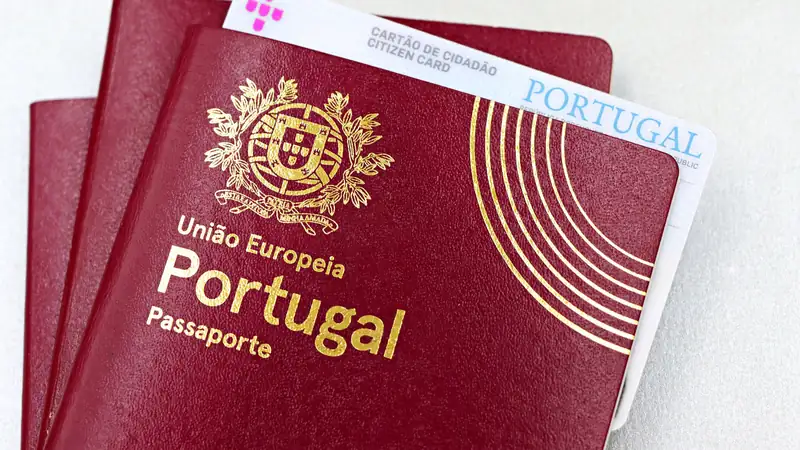
Citizen Card and passport
Portuguese documents after citizenship.
Learn more →Common questions
Didn't find your question? Talk to our team on WhatsApp.
Does the child of a Portuguese mother have the same right as the child of a Portuguese father?
Yes. Portuguese law grants children of Portuguese citizens citizenship by origin (by attribution) and makes no distinction as to whether the Portuguese parent is the applicant's father or mother. The child's place of birth is also irrelevant. Because it is citizenship by origin, it can later be passed on to the applicant's descendants.
Does the Portuguese father or mother need to be alive for the child to apply for citizenship?
No. The Portuguese ascendant does not need to be alive for the child to obtain citizenship. For the Portuguese ascendant's birth certificate, a plain copy or the corresponding details are even sufficient: full name, parents' names, date of birth, municipality (concelho) and parish (freguesia) of birth.
Which documents are required for an application by the child of a Portuguese citizen?
The application by the child of a Portuguese citizen requires the birth certificates of the ascendant and of the applicant, an apostilled personal identity document with photo and a signed private power of attorney.
- birth certificate of the Portuguese ascendant (plain copy or details);
- full-content, photocopy-format birth certificate of the applicant, with notarial recognition and Hague Apostille;
- certified copy of a valid personal identity document with photo (RG, CNH or passport), with Hague Apostille;
- signed private power of attorney.
If the applicant is over 70, a public power of attorney with a Hague Apostille is requested, for proof of life.
When is it mandatory to first transcribe the parents' marriage?
Prior transcription of the parents' marriage is mandatory in two situations: when both parents are Portuguese, or when only the mother is Portuguese and she was not the person who declared the child's birth. In all other cases, the application for attribution proceeds with the usual documents, without this preliminary step.
Latest articles

Portugal 2026: a timeline of the changes in citizenship, visas and the Golden Visa
Golden Visa without real estate, the end of the expression of interest, the CPLP route with a visa, citizenship after 7 years and IFICI in place of the NHR: the changes from 2023 to 2026 in chronological order, with the rule behind each one and what applies today to each profile.

Golden Visa for the family: who can be included and how reunification works
Spouses, minor children, adult children who are studying and dependent parents can accompany the Golden Visa investor, without the two-year wait. See who qualifies, who does not, documents, fees and renewals.

D7 visa in 2026: how much income to prove and how to build the financial file
The official €920 minimum wage benchmark, simulations for couples and children, what kind of income the consulate accepts, the role of a bank account in Portugal and a step-by-step guide to the D7 visa financial file.