
Living in the Algarve: A Practical Guide for Brazilians (Cost of Living, Documents, Healthcare and Schools)
Rent based on the official INE median for each municipality, visa and documents, SNS user number, PB4, school enrollment and equivalence: what to organize to live in the Algarve when moving from Brazil.
The Algarve is no longer just a vacation destination. For many Brazilian families, it has become a permanent address: a mild climate, towns smaller than Lisbon, an active Brazilian community and the chance to live near the sea with a city routine. Official figures confirm the trend. According to the Resident Population Estimates from INE (Statistics Portugal), released in June 2026, the Algarve was the region of Portugal where the population grew the most, in relative terms, between 2021 and 2025 (13.8%). At the end of 2025, the region had 161,556 residents of foreign nationality, 27.9% of its population, the highest share in the country. And Brazilians are the largest foreign community in Portugal, with 574,195 people.
This guide brings together what usually weighs on the decision and on the first months: how much it costs to live there, which documents to organize, how public healthcare works and how to enroll your children in school. We use only data from official sources, with the date of each one, so that you can plan with real numbers.
How much it costs to live in the Algarve: housing comes first
For newcomers, rent is usually the largest fixed expense, and it is also the item with the most reliable official statistics. Every quarter, INE publishes the median rent per square meter of new lease agreements, that is, of the agreements actually signed and reported to the Tax Authority, not of the asking prices in listings.
In the September 29, 2026 release (Housing Rent Statistics at Local Level, Q2 2026), the Algarve recorded €11.56/m² for the quarter, compared with €10.17/m² for Portugal as a whole. Only Greater Lisbon, Madeira and the Setúbal Peninsula had higher values. Compared with the same quarter of 2025, the median rent in the Algarve rose 9.8%.
Median rent by municipality (12 months to June 2026)
Because the number of agreements each quarter is small in some municipalities, INE also publishes the cumulative value for the last 12 months. In the Algarve municipalities with a published value:
- Lagos: €12.77/m²
- Loulé: €12.33/m²
- Albufeira: €12.22/m²
- Portimão: €11.70/m²
- Tavira: €11.46/m²
- Faro: €10.29/m²
- Silves: €10.19/m²
- Lagoa: €9.93/m²
- Vila Real de Santo António: €9.92/m²
- Vila do Bispo: €9.36/m²
- Castro Marim: €9.18/m²
- Aljezur: €8.99/m²
- Olhão: €8.75/m²
- Monchique: €7.41/m²
- São Brás de Alportel: €6.93/m²
For comparison, the national median for the same period was €9.76/m², and the Algarve median was €10.96/m². In practice, an 80 m² apartment rented at the Albufeira median would cost about €978 per month; at the Olhão median, about €700. This is a reference calculation: half of the agreements are above the median, and furnished properties, properties with a sea view or in high-demand areas tend to be above it.
Other prices
For the rest of the budget (groceries, energy, transportation), it is worth following inflation. According to the flash estimate from INE, the consumer price index rose 3.6% in the 12 months to September 2026, driven mainly by fuel. The final data will be published on October 13.
Before signing the lease
In Portugal, a residential rental agreement is called a lease (arrendamento) and must be made in writing (Art. 1069 of the Portuguese Civil Code). No one may be discriminated against in access to housing rentals on the grounds of nationality, origin or language (Art. 1067-A). Before transferring any money, confirm the landlord's identity, the occupancy permit (licença de utilização) and what the agreement says about the term, the security deposit and rent updates. Our page on renting in Portugal explains each clause and the most common signs of fraud.
Documents: what to sort out while still in Brazil
The right visa, before you travel
Brazilians can enter Portugal without a visa for short stays, but that entry is for tourism, visits and business, not for living there. In recent years, Portugal has closed the routes that allowed people to enter as tourists and regularize their status later. For this reason, the path for anyone who wants to live in the Algarve generally starts with a residence visa applied for in Brazil, chosen according to the reason for the move: work, self-employment, study, family reunification, own income (D7) or remote work (D8), among others. Our page on visas for Portugal compares each one.
With the residence visa, a residence pre-authorization is issued, with the provisional assignment of tax, social security and National Health Service numbers (Art. 58(6) of Law 23/2007, the Foreigners Act (Lei de Estrangeiros)). Once in Portugal, the next step is the residence permit (autorização de residência) from AIMA (Agency for Integration, Migration and Asylum). People who hold a residence visa or have already applied for a permit can request the NIF (tax number), the NISS (social security number) and the SNS user number all at once, through an AIMA service described on the gov.pt portal.
Certificates and powers of attorney
Bring up-to-date Brazilian certificates (birth, marriage, criminal record, your children's school transcripts) with the Hague apostille, issued by Brazilian notary offices, according to the CNJ (Brazil's National Council of Justice). Documents written in Portuguese generally do not need to be translated. If any matter remains pending in Brazil, such as the sale of a property or the follow-up of an estate inventory, leave a well-drafted power of attorney before you travel. See the pages on apostille and translation of documents and on powers of attorney between Brazil and Portugal.
Once you live in the Algarve, Brazilian consular services (birth and marriage registrations, powers of attorney, passports) are handled by the Consulate General of Brazil in Faro.
Taxes: do not forget the Brazilian side
Anyone who moves to Portugal should consider the definitive departure from Brazil (for tax purposes) and the new tax residence, so as not to be treated as a resident of both countries. INSS (Brazilian National Social Security Institute) retirees have their own income tax rules. See the pages on tax residence between Brazil and Portugal and on INSS retirees in Portugal.
Planning your move to the Algarve? Sene & Araújo has offices in Albufeira and São Paulo, with lawyers admitted to the Brazilian Bar Association (OAB) and the Portuguese Bar Association (Ordem dos Advogados). Talk to our team to review the visa and documents for your case.
Healthcare: the SNS and the user number
Portugal has a public system, the National Health Service (Serviço Nacional de Saúde, SNS), organized into health centers and hospitals. For foreign nationals, the national user number (número de utente) is assigned the first time the person goes to a public health facility, such as a health center or a hospital, according to gov.pt. The same page warns that assigning the number does not, by itself, mean the SNS will cover the costs. For this reason, it is advisable to have your residence process in order and to bring your identification documents, your NIF and proof of address in the Algarve.
User fees
Since June 2022, user fees (taxas moderadoras) are no longer charged for SNS services, except for hospital emergency care without prior referral by the SNS or without subsequent hospital admission (SNS). According to the Health Regulatory Authority (Entidade Reguladora da Saúde), referrals are made through the SNS 24 Line or by health centers. In practice: before going to an emergency department for a problem that is not serious, call SNS 24.
What about the PB4 (CDAM)?
The Certificate of Entitlement to Medical Care (CDAM), known as PB4 when the destination is Portugal, results from the social security agreement between the two countries and allows Brazilians to be treated in the Portuguese public health system on the same terms as local citizens. According to Brazil's Ministry of Health, for Portugal the application requires an RG (Brazilian identity card), CPF, a valid passport and proof of residence in Brazil. It is therefore useful while you still live in Brazil, for example on scouting trips; after the move, the path is to register with the SNS as a resident.
Schools: enrollment, equivalence and language
Free public school from ages 6 to 18
Compulsory schooling in Portugal covers children and young people between the ages of 6 and 18. Within this scope, education is universal and free, with no tuition fees (propinas) and with exemption from enrollment, attendance and certification fees, in addition to school social support (Arts. 2 and 3 of Decree-Law 176/2012 (Decreto-Lei)). Enrollment is generally done through the Enrollment Portal (Portal das Matrículas) or directly at the school.
Equivalence of studies completed in Brazil
For the student to continue in the right grade, equivalence of the Brazilian qualifications must be requested at the time of enrollment, at the school itself, according to the frequently asked questions of the Directorate-General for Education (DGE). The rules are set out in Decree-Law 227/2005, and certification of equivalence is free of charge. Among other documents, the DGE asks for:
- the application on the official form;
- the school documents proving the years successfully completed (certificate, diploma, school transcript), with the Hague apostille;
- the final grades and the grading scale, including the minimum passing grade.
A warning from the DGE itself: equivalence is granted based on completed school years, and not only on the basis of exams such as ENEM or ENCCEJA. For this reason, ask the Brazilian school for the complete school transcript before you travel. For higher education degrees, the path is different; see the page on recognition of degrees.
Portuguese as a Non-Native Language? Not for Brazilians
Portuguese schools offer the subject Portuguese as a Non-Native Language (Português Língua Não Materna, PLNM) to students whose native language is not Portuguese. The DGE stresses that students of Brazilian nationality, whose native language is Portuguese, should not be placed in PLNM. In this case, the adjustment is to European Portuguese and to the new curriculum, not to the language.
If the move involves children and assets
- Children of separated parents: moving abroad with a minor child requires the consent of the other parent or a court decision. See the page on child custody between Brazil and Portugal.
- Assets that remain in Brazil: real estate, investments and companies remain subject to Brazilian law and taxes. See the page on assets in Brazil for those living in Portugal.
- Inheritance and wills: once you establish your habitual residence in Portugal, Portuguese law will generally govern your succession, including with respect to assets in Brazil. It is worth reviewing your planning; see the page on international succession.
Checklist before the move
- a residence visa suited to the reason for the move, applied for in Brazil;
- a valid passport for the whole family;
- up-to-date, apostilled birth and marriage certificates;
- apostilled criminal record certificates, when required for the visa;
- your children's complete school transcripts, with the grading scale, apostilled;
- authorization from the other parent or a court decision, if there is a minor child of separated parents;
- powers of attorney for matters that remain pending in Brazil;
- planning for the definitive departure and tax residence;
- savings for the first months of rent, taking into account the median for the chosen municipality.
Common mistakes
- Entering as a tourist to "sort it out there". Since the amendments of 2024 to 2026, the rule is to obtain the residence visa in Brazil.
- Budgeting rent based on the cheapest listing. The official median for the municipality is a more reliable reference.
- Paying a security deposit without a written agreement or without checking who the landlord is.
- Traveling without the complete school transcript and delaying your children's equivalence.
- Forgetting the Brazilian tax side and remaining a resident of both countries.
How Sene & Araújo can help
Sene & Araújo has offices in Albufeira, in the center of the Algarve, and in São Paulo, and works directly in Brazil and Portugal. The team assists with choosing and applying for the visa, the residence permit, the review of the lease agreement, powers of attorney and the family and asset matters that come with the move. Contact us for an initial conversation about your case.
Official sources
- INE — Housing Rent Statistics at Local Level, Q2 2026 (September 29, 2026), with tables by municipality
- INE — Resident Population Estimates 2025 (June 22, 2026)
- INE — CPI flash estimate, September 2026 (September 30, 2026)
- gov.pt — Obtaining the SNS national user number (updated May 12, 2026)
- gov.pt — Requesting the NIF, NISS and user number for foreign nationals (AIMA)
- SNS — End of user fees (Decree-Law 37/2022)
- ERS — SNS user fees (frequently asked questions)
- Ministry of Health (Brazil) — Certificate of Entitlement to Medical Care (CDAM/PB4)
- Decree-Law 176/2012 — compulsory schooling (Arts. 2 and 3)
- DGE — FAQ on equivalence of foreign qualifications (Decree-Law 227/2005)
- DGE — Portuguese as a Non-Native Language
- Enrollment Portal (Portal das Matrículas)
- CNJ — Hague apostille
- Consulate General of Brazil in Faro
- Law 23/2007 (Art. 58(6)) and Portuguese Civil Code (Arts. 1067-A and 1069) — as described on the firm's visa and renting pages
Informational article, current as of the date shown; it does not replace a review of your specific case.
About the authors
Sene & Araújo Sociedade de Advogados team. Content prepared and reviewed by the firm's lawyers, admitted to the Brazilian Bar Association (OAB) and the Portuguese Bar Association (Ordem dos Advogados), with offices in São Paulo and Albufeira. The provisions cited were checked against the official sources listed above. Meet the team.
Common questions
Didn't find your question? Talk to our team on WhatsApp.
How much does it cost to rent an apartment in the Algarve?
According to INE data, the median rent of new agreements in the Algarve was €11.56/m² in Q2 2026. In the 12 months to June 2026, Algarve municipalities ranged from €6.93/m² in São Brás de Alportel to €12.77/m² in Lagos; in Albufeira, the median was €12.22/m². An 80 m² apartment at the Albufeira median would cost about €978 per month.
Can Brazilians use the SNS in Portugal?
Yes. The user number is assigned on the first visit to a public health facility. Assigning the number does not, by itself, mean the costs will be covered, so it is advisable to have your residence status regularized. User fees are only charged for hospital emergency care without prior referral.
Is the PB4 useful for people who live in Portugal?
The CDAM (PB4) is applied for in Brazil, with proof of residence in Brazil, and allows treatment in the Portuguese public health system on the same terms as local citizens. After the move, the path is to register with the SNS as a resident.
Will my child lose a school year?
Not necessarily. Equivalence is requested at the time of enrollment, at the school itself, is free of charge and takes into account the years successfully completed in Brazil. Bring the complete, apostilled school transcript, with the grading scale.
Do you have to pay for public school in Portugal?
No. During compulsory schooling, from ages 6 to 18, public education is universal and free, with no tuition fees and with exemption from enrollment, attendance and certification fees (Decree-Law 176/2012).
Talk to our team
Tell us about your case: we will reply by email and, if you prefer, schedule a video call.
Latest articles
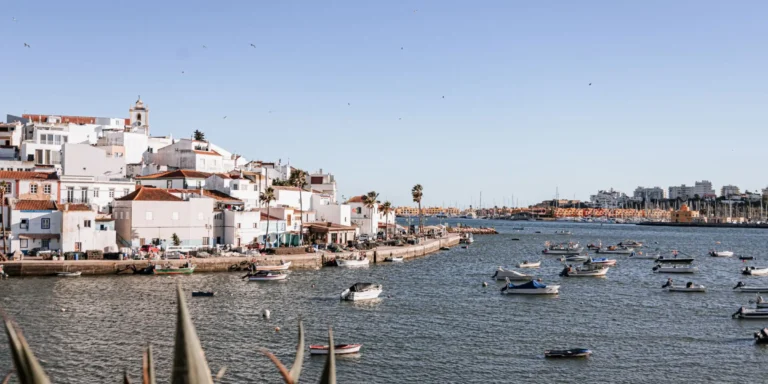
Living in the Algarve: a practical guide for Brazilians (cost of living, documents, healthcare and schools)
Rent based on the official INE median for each municipality, visa and documents, SNS user number, PB4, school enrollment and equivalence: what to organize to live in the Algarve when moving from Brazil.
Sene & Araújo · 11 min readOctober 19, 2026
Portuguese citizenship approved: what now? The next steps
Has your case been completed at the IRN? See the practical order of the next steps (certificate, marital status, Citizen Card, passport, children, spouse, NIF and tax residence) and the mistakes that most often delay people who have just become Portuguese.
Sene & Araújo · 10 min readOctober 18, 2026
IFICI: the tax regime that replaced the NHR in Portugal — who can use it
IFICI applies a 20% IRS rate to employment and self-employment income from qualifying activities for 10 years. See who can use it, the eligible professions and companies, the registration deadline and how income from Brazil is treated.
Sene & Araújo · 13 min readOctober 17, 2026